
Leading Through and Beyond Our Wounds
November 17, 2025
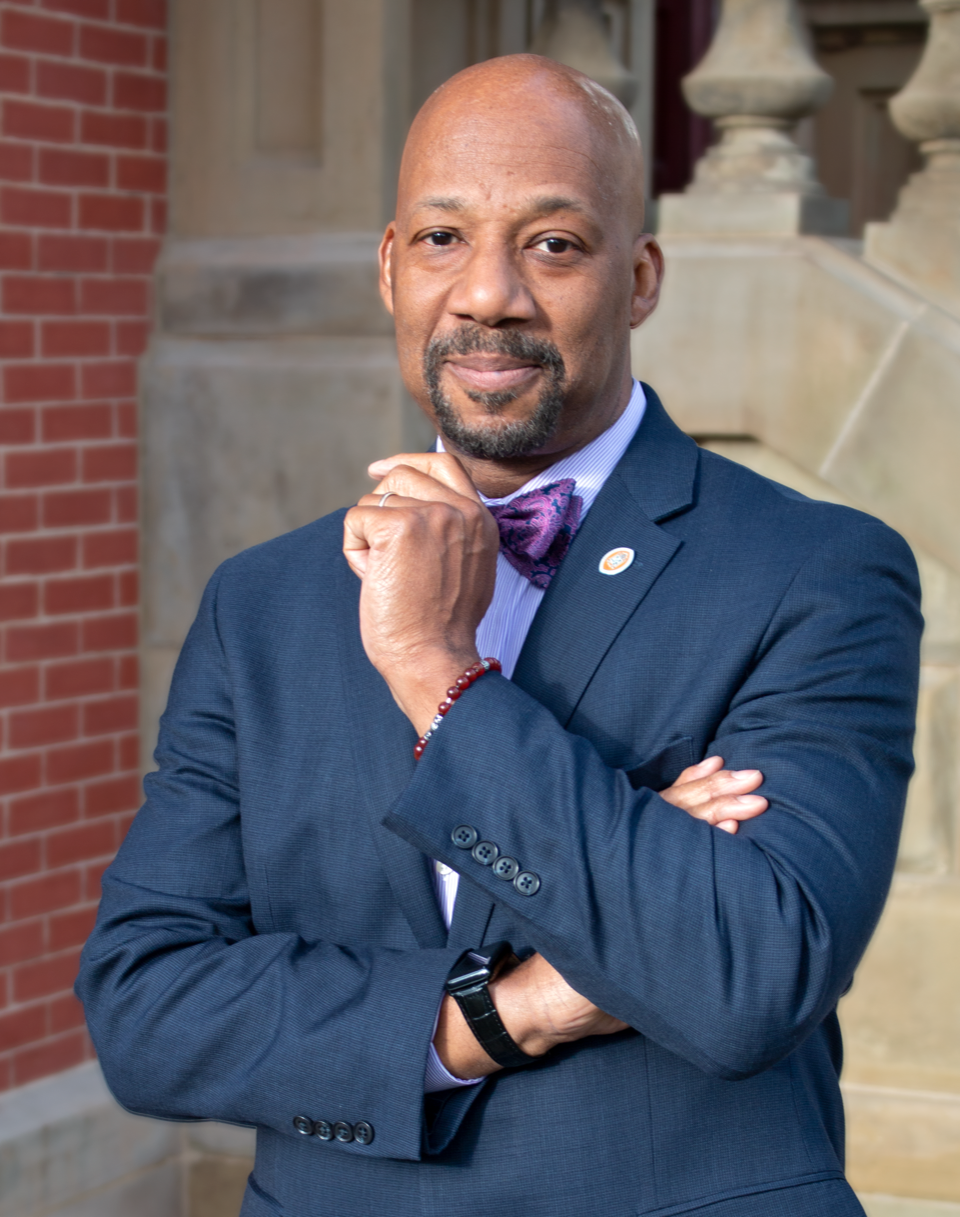
Rev. Micah L. McCreary, Ph.D.
President
John Henry Livingston Professor of Theology
On November 7, 2025, I made several presentations at Boston University School of Theology (BU-STH) focused on the transformative journey of trauma-responsive leadership. During the lecture and podcast conversations, I emphasized my position that leaders lead more effectively when they embrace, understand, and transcend personal and collective wounds. Drawing from my early formative experiences and later deep personal transformational experiences, I proposed that trauma is experienced in the body and that we as theologians and mental health professional must refine our trauma delivery systems by integrating psychological insight with theological grounding.
I opened the lecture with a ritual ceremony honoring the Trinity, our ancestors, my teachers and students, as well as the Dean, faculty, staff, and students of BU-STH. I then introduced Isaiah 40:28–31 as the organizing scripture and played the song “Take This Cup” by Makeda McCreary. This introduction was intended to establish that both the lecture and the podcast would reflect a deeply personal and spiritual integration and embodiment of the theme.
I then continued the conversation with a discussion of three critical foci.
First: Trauma-Responsive Leadership
Here I defined trauma-responsive leadership: “Leadership that acknowledges personal and collective wounds, understands their impact, and responds with empathy and resilience.”
Using the concept of the Soul Wound, I explored trauma-responsive leadership. A Soul Wound—sometimes referred to as a Father Wound—describes deep psychological and spiritual pain rooted in disrupted parental relationships. It often emerges when an individual struggles to integrate their animus (inner masculine) and anima (inner feminine) identities. This challenge can arise from the absence of a parental figure or from complex relational dynamics, even when parents are physically present.
I explained that Soul Wounds shape us both physically and emotionally, often rooted in parental absence or inconsistent presence. These wounds frequently manifest as Attachment Challenges—for example, a parent who is physically absent but psychologically present, or physically present yet emotionally disconnected. Soul Wounds ultimately lead to various Heart Conditions:
- Bruised Heart–Injured, battered, and hurting;
- Performance-Based Heart–Driven by acceptance and glory-seeking;
- Hardened Heart–Cut off, cold, and callous; and/or
- Addicted Heart–Yearning, empty, and hungry.
After presenting the conceptual framework, I shared my experience of the Soul Wound—born from the emotional and physical injuries that followed the devastation of Post-Traumatic Stress Disorder (PTSD). I discussed how I developed a Performance-Based Heart and have been driven ever since by a powerful need for perfection and glory. I concluded this portion of the lecture with the emphasis that the Soul Wound matters: “Our communities and congregations are carrying layers of trauma—historical, systemic, and personal. Leaders must be equipped to navigate this reality.”
Second: Embracing and Transcending Wounds
I explored the paradox: “We lead not despite our wounds, but through them. Our scars can become bridges to healing for others.” This principle guided my discussion of the Peacemaker–Healer–Warrior–Hero paradigm introduced in my book Trauma and Race: A Path to Well-Being (p. 124). Each archetype exists on a continuum: Peacemaker aligns with Warrior, and Hero aligns with Healer. In pastoral and therapeutic relationships, my goal is to help individuals move along these continuums toward wholeness.
Over time, through therapy, practice, and marriage, I have come to identify most strongly with the Peacemaker–Healer quadrant—a space that reflects my preferred way of leading and living. To illustrate how psychological awareness and vulnerability create safe spaces for others to heal, I shared a deeply personal animus–anima experience.
One evening, while watching a movie, I became unexpectedly angry at a scene where a woman was mistreated. I turned off the television and began reflecting. I recognized that this anger—unusual for me—signaled a trigger. Working with my therapist, I traced the reaction back to two formative incidents. At age ten, I witnessed my father abusing my mother. I ran outside with a mop handle to defend her, only to be told that the man hurting her, my father, was to be respected. Years later, at sixteen, I returned home to find my mother assaulted by a boyfriend. This time, I intervened forcefully before anyone could stop me.
Both actions, rooted in the Warrior–Hero quadrant, led to painful consequences—physical beatings. In response, I pushed the Warrior–Hero aspects of my personality into the shadow, while my Performance-Based Heart—driven by perfection and glory—became my outward persona. Yet, this persona (peacemaker-healer) was always powered by that hidden hero-warrior energy.
Integrating these parts of myself was a long journey. During a lecture on nonviolence, a disciple of Martin Luther King Jr. insisted that I must always remain nonviolent. I asked, “If I come home and a man is abusing my spouse, should I remain nonviolent?” He replied that I should respect my spouse enough to let her decide. Later, I asked my wife what she wanted me to do. Her answer was clear: “If you don’t come to my rescue, you’d better hope I don’t survive—because if I do . . .” That conversation reframed my understanding of love, respect, and responsibility.
I also shared a moment that revealed the enduring presence of my Warrior–Hero shadow. After an active shooter drill, I told my students that if a shooter entered our lecture hall, I would confront him first knowing it could cost me my life, hoping it would buy them time to escape. Unbeknownst to me, a shooter was in that very class. He later turned himself in, telling police he abandoned his plan because he “did not want to kill McCreary.”
Third: Integrating Theology and Counseling Psychology
This part of the lecture highlighted my interdisciplinary approach to teaching, counseling, preaching, mentoring, coaching, and consulting—an approach grounded in the power of relationship. I firmly believe that Carl Rogers’ development of humanistic psychology and person-centered therapy was deeply influenced by his early aspiration to become a minister. His clinical journey began with children at the Rochester Society for the Prevention of Cruelty to Children, reflecting this foundational commitment.
I shared how much my daughter taught me about congruence, unconditional positive regard, and empathy. Through parenting, I learned that love must be paired with limits. To truly nurture her growth, I had to operate in the quadrant of high love and high limits—offering deep affection while teaching her to respect boundaries. This experience shaped my understanding of authoritative parenting and informed my clinical perspective.
From these lessons, I refined a system that integrates psychological insight with theological grounding. I learned to love from our Creator–Redeemer–Sustainer and to embrace vulnerability from our Shepherd-King, whom I understand as the true prophet who loved us to the point of death. This is the model of leadership: one who embodies vulnerability and creates safe spaces for others to heal. Such integration affirms a vital truth: “Faith without understanding human behavior lacks depth; psychology without spiritual grounding lacks hope.”
This fusion of theology, psychology, and clinical practice equips pastoral psychologists and cultivates trauma-informed practitioners. It builds a pipeline of leaders prepared to respond to trauma within congregations and communities. When leaders connect lived experience with faith, ministry becomes real, relatable, and transformative. This connection enables leaders to serve with empathy and strength—even in the face of adversity.
In closing, my message at BU-STH was clear: Leadership is not about perfection—it’s about presence. When we lead through and beyond our wounds, we turn pain into purpose and leadership into a healing practice.